








This article provides a summary of key findings from Dovetail Software’s HR Service Delivery Pulse Survey. Readers can download the full survey report for complete results, charts, and detailed analysis.

Key Points
- HR leaders consistently prioritize ease of use, employee self-service, flexibility, reporting, and measurable ROI when evaluating HR technology
- Dovetail customer case studies show how these priorities appear in day-to-day HR Service Delivery operations
- Observed outcomes include reduced case volume, improved adoption, better visibility into demand, and greater HR control
HR teams deal with a steady flow of employee questions, changing policies, and increasing expectations around responsiveness and consistency. In many organizations, the challenge is not a lack of intent or effort, but the limitations of the systems used to deliver HR services.
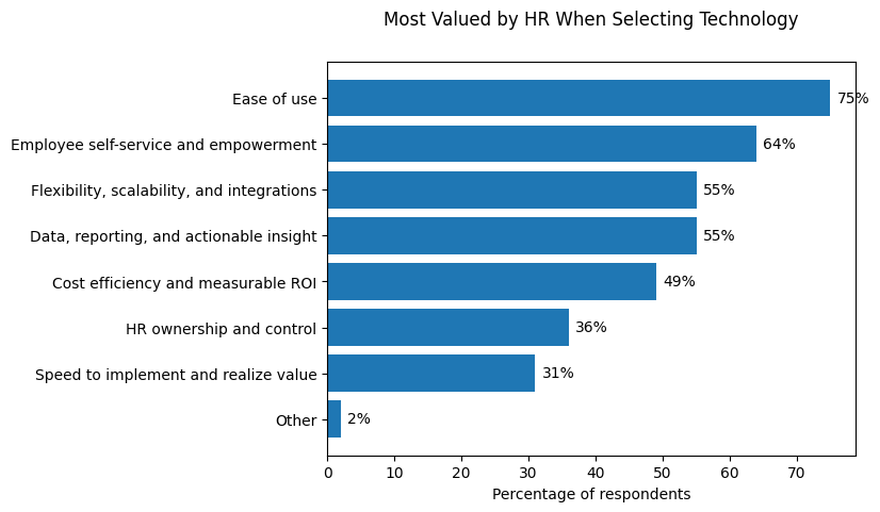
In Dovetail's HR Service Delivery Pulse Survey, HR leaders consistently point to a small set of priorities when evaluating HR technology:
-
Ease of use
-
Employee self-service,
-
Flexibility
-
Reporting and insight
-
Measurable ROI
This article looks at what those priorities look like in practice, using Dovetail customer case studies as concrete examples.
This is not a summary of the survey. It is an examination of how the priorities HR leaders describe translate into observable outcomes in real environments.
Ease of Use in Practice
In the Pulse Survey, 75 percent of respondents cite ease of use as their most important consideration when selecting HR technology. Respondents associate ease of use with both employee access and HR day-to-day administration.
At Tower Health, which supports approximately 14,000 employees, HR adopted the Dovetail Employee Portal to centralize HR communication. Employees accessed information more consistently, HR response times improved, and overall HR workload decreased. The system supported consistent HR Service Delivery across a large and distributed workforce.
When HR is managing a high volume of employee questions and inconsistent access to information, Dovetail Employee Portal enables employees to find HR information through a single, centralized interface. As a consequence, Dovetail customers report nearly 100 percent positive employee feedback, faster access to answers, and a reduction in HR case volume.
The takeaway is that employee adoption increases where systems are easy to navigate and manageable for HR teams to maintain.
Employee Self-Service and Demand Reduction
The Pulse Survey shows that 64 percent of respondents prioritize employee self-service, and 56 percent say they want to simplify the employee experience. These responses reflect a practical objective: reducing repetitive questions and follow-ups that consume HR capacity.
At First Midwest Bank (now Old National), HR teams were handling a high volume of routine employee inquiries. After deploying the Dovetail Employee Portal, employees were able to resolve common questions independently. Routine case volume decreased, response times improved, and employee engagement increased.
When organizations implement the Dovetail Employee Portal alongside HR Case Management, they can support employees across remote and distributed environments and provide consistent access to HR support regardless of location. Employees are able to use self-service for routine needs, while HR retains oversight of more complex cases.
Self-service reduces demand on HR resources when employees can reliably find accurate information without creating a case.
Flexibility and the Ability to Scale
In the Pulse Survey, 55 percent of respondents value flexibility, scalability, and integration, while 31 percent identify slow setup and change management as a key frustration.

Lenovo required improved SLA tracking, reporting, and case hierarchy across global HR Services. After implementing Dovetail HR Case Management, HR teams gained clearer visibility into service levels and demand. Workflows were configured directly by HR, allowing global operations to scale without repeated system changes or IT dependency.
At Northside Hospital, HR experienced duplicate cases and limited flexibility in workflows. Following the adoption of Dovetail HR Case Management, case handling became more consistent, reporting accuracy improved, and workflow changes could be made quickly as requirements evolved.
In both organizations, flexibility reduced delays associated with system changes and supported ongoing adaptation.
Reporting, Insight, and Operational Control
The Pulse Survey indicates that 55 percent of respondents prioritize reporting and insights.
Swire Coca-Cola implemented Dovetail Employee Relations Case Management to improve documentation, tracking, and collaboration. Centralized case records and reporting supported more consistent handling of employee relations matters and improved operational efficiency.
Reporting was used to understand patterns in data, support governance, and inform operational decisions.
HR Ownership and Ongoing Change
Across the case studies, HR teams retained control over workflows, knowledge, and configuration. Because Dovetail is no-code and HR-owned, teams were able to adjust processes and content as needs changed, without relying on IT or external consultants. This reduced delays and supported continuous improvement rather than one-time optimization.
What These Examples Show
Across organizations, similar patterns appear:
- Adoption increased where systems were easy for employees to navigate
- Case volume decreased when self-service content was reliable and accessible
- HR efficiency improved when workflows and reporting were controlled by HR
- Scale was achieved without reimplementation or increased technical dependency
These outcomes align closely with the priorities HR leaders describe in the Pulse Survey, but are illustrated here through observed results rather than survey responses alone.
Conclusion
The HR Service Delivery Pulse Survey highlights what HR leaders say they value when selecting technology. The Dovetail customer case studies show how those priorities appear in practice across different industries, workforce sizes, and operating models.
For HR teams evaluating their own HR Service Delivery approach, these examples provide concrete reference points for how ease of use, self-service, flexibility, insight, and HR ownership affect day-to-day outcomes.
Frequently Asked Questions
What do HR leaders value most in HR Service Delivery technology?
HR leaders consistently point to ease of use, employee self-service, flexibility, reporting and insight, and measurable return on investment.
How does employee self-service reduce HR workload?
When employees can reliably find answers to routine questions, fewer cases are created and HR teams spend less time handling repetitive inquiries.
Why does HR ownership matter in HR Service Delivery?
HR ownership allows teams to update workflows, knowledge, and processes quickly as needs change, without relying on IT or external consultants.