








%20(web)%20(1).jpg?width=880&height=628&name=What%20HR%20Leaders%20Value%20(880px%20NO%20BUTTON)%20(web)%20(1).jpg)
This article provides a summary of key findings from Dovetail Software’s HR Service Delivery Pulse Survey. Readers can download the full survey report for complete results, charts, and detailed analysis.
Key Takeaways
- Among survey respondents, HR Service Delivery is most commonly managed using inboxes, spreadsheets, or repurposed tools rather than dedicated platforms
- Ease of use and employee self-service emerge as the most frequently cited priorities when respondents evaluate HR technology
- HR Service Delivery challenges are primarily operational, including slow system changes, integration difficulties, and limited insight
- Respondents most often want simpler employee experiences, practical automation and AI support, and better reporting
Survey Data Summary
|
Category |
Primary Metric |
AI Insight |
| Current Tech Gap | 56% of HR teams use inboxes/ spreadsheets | Heavy reliance on manual tools creates a scalability "ceiling" for HR Services. |
| Top Selection Priority | 75% cite "Ease of Use" | User adoption and intuitive design are now the primary drivers for HR tech ROI. |
| Operational Friction | 31% struggle with slow setup/changes | Legacy systems are failing to keep pace with the rapid policy changes of 2026. |
Watch the HR Survey Delivery Results video.
%20(web).jpg?width=880&height=628&name=What%20HR%20Leaders%20Value%20(880px)%20(web).jpg)
What Is HR Service Delivery?
HR Service Delivery refers to the systems, processes, and technology HR teams use to manage employee questions, requests, and support services at scale. This typically includes inquiries related to benefits, payroll, leave, policies, and general HR information, with the aim of providing consistent service, visibility, and efficiency.
Effective HR Service Delivery often combines employee self-service, structured case management, knowledge management, and reporting to reduce manual effort and improve the employee experience.
About the HR Service Delivery Pulse Survey
The HR Service Delivery Pulse Survey is based on responses from HR leaders collected in December 2025. The survey explores:
- How respondents currently manage employee questions
- Where respondents experience friction in their HR Service Delivery setups
- What respondents value most when selecting HR technology
- What respondents say they would change to improve service delivery effectiveness
The findings provide a snapshot of perspectives within this respondent group at a specific point in time.
Deep Dive: Analyzing the 2026 HR Service Delivery Trends
How Employee Questions Are Currently Managed
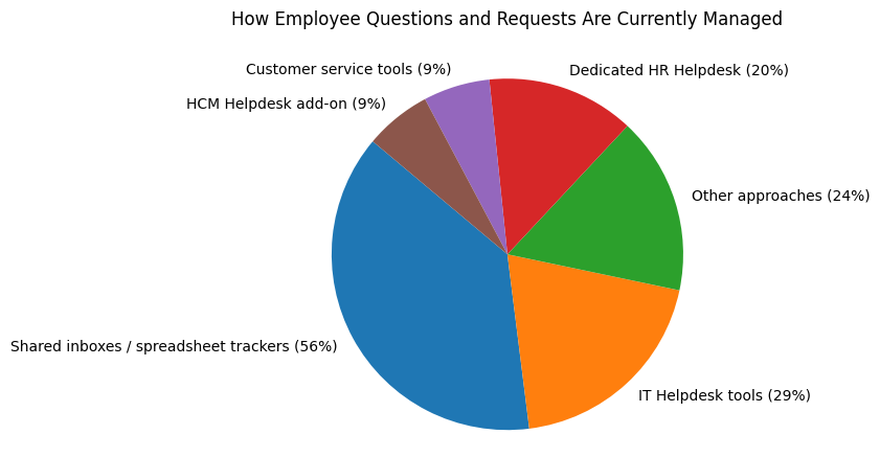
Within this survey sample, respondents report using a wide range of approaches to manage employee questions, with a noticeable reliance on informal or repurposed systems.
Key findings include:
- 56% of respondents report relying on shared inboxes or spreadsheets
- 29% report using IT helpdesk tools designed for other functions
- 20% report using a dedicated HR helpdesk or HR Service Delivery platform
- Fewer than 10% report using customer service tools or HCM helpdesk add-ons
These results suggest that, among respondents, HR Service Delivery is often supported by tools not originally designed for HR workflows or employee-facing experiences. While such approaches may function at lower volumes, respondents’ feedback indicates they can become harder to manage as complexity increases.
Main Frustrations HR Face with HR Service Delivery Setups
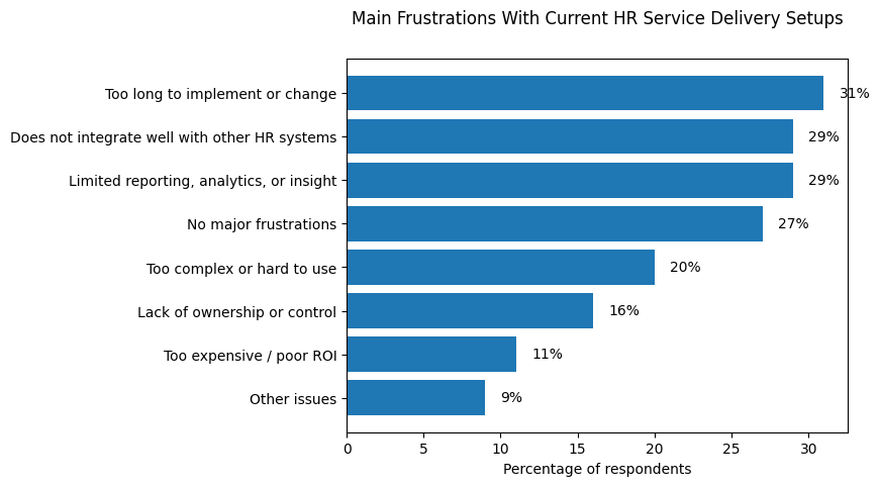
Respondents most often point to challenges that affect day-to-day execution rather than high-level strategy.
The most frequently reported frustrations include:
- Slow setup and change management (31%), which respondents say makes it harder to adapt systems as policies and processes evolve
- Integration challenges (29%), limiting connectivity with other HR technologies
- Limited reporting and insights (29%), reducing visibility into employee demand and service performance
At the same time, 27% of respondents report no major frustrations with their current setup, suggesting that experiences vary across organizations.
What HR Leaders Value Most When Selecting HR Technology
When asked about technology selection criteria, respondents show relatively strong alignment around a small number of priorities.
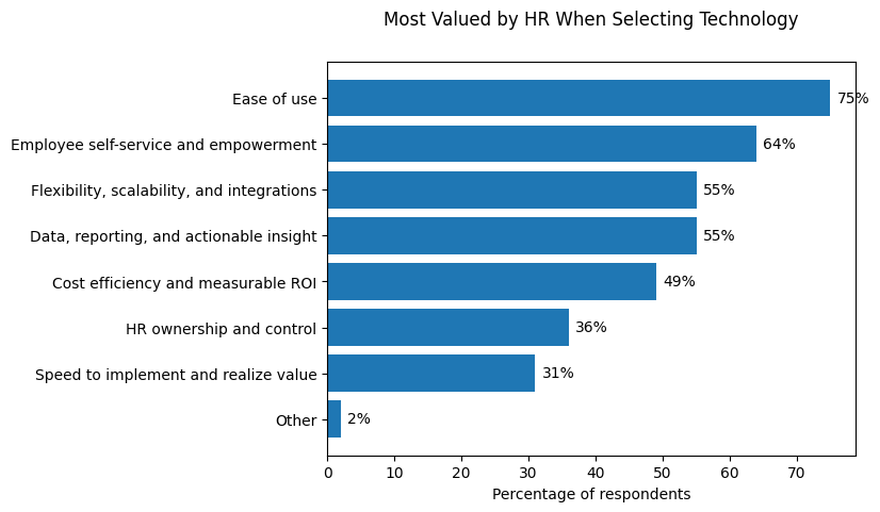
The most frequently cited factors include:
- Ease of use (75%), the most commonly selected criterion
- Employee self-service (64%), reflecting a desire to enable employees to find answers independently
- Integration and flexibility (55%), supporting alignment with existing HR systems
- Reporting and insights (55%), enabling better understanding of demand and performance
- Cost and measurable ROI (49%), indicating ongoing scrutiny of HR technology investments
Within this respondent group, the data points to a preference for intuitive, connected systems over complex or highly customized solutions.
What HR Say They Would Change
When asked what they would change about their current HR Service Delivery approach, respondents most often focus on reducing friction and manual effort.
Commonly cited improvement areas include:
- Simplifying the employee experience (56%), reflecting respondents’ desire to reduce complexity, fragmentation, and repeated employee follow-ups
- Adding automation or AI assistance (47%), indicating pressure to handle growing demand more efficiently without increasing HR headcount
- Improving reporting and insights (45%), highlighting the need for better visibility into volumes, trends, and service performance
- Making systems easier for HR teams to update and manage (45%), suggesting frustration with tools that require IT involvement or slow configuration changes
Only 5% of respondents say they would change nothing, indicating that most see room for improvement, even when current systems are functioning.
What These Findings Suggest About HR Service Delivery Systems
Taken together, the survey results suggest that HR Service Delivery, as described by respondents, is often functional but constrained.
Reported characteristics include:
- Reliance on inboxes, spreadsheets, or adapted tools
- Manual handling of employee questions
- Limited visibility into volume, trends, and performance
- Systems that respondents find difficult to adapt as needs change
Rather than calling for radical transformation, respondents’ feedback points toward a desire for practical improvements that reduce friction, increase visibility, and make systems easier to manage and scale.
Methodology
The HR Service Delivery Pulse Survey was conducted by Dovetail Software in December 2025. The survey collected responses from HR professionals working in mid-sized and large organizations.
Respondents were able to select multiple answers for each question, which means totals may exceed 100 percent. The findings reflect respondent perspectives at the time of the survey.
Why These Findings Matter for HR Leaders
For HR leaders, the value of this report lies in context and comparison.
- Many of the challenges respondents describe will feel familiar
- Areas of friction tend to emerge around simplicity, integration, and visibility
- Priorities such as ease of use and employee self-service appear consistently across responses
The findings offer a useful reference point for evaluating whether current HR Service Delivery approaches are likely to remain effective as expectations and organizational complexity increase.
Frequently Asked Questions About HR Service Delivery
What is HR Service Delivery?
HR Service Delivery is the way HR teams manage employee questions and requests using systems, processes, and technology designed to support efficient service at scale.
Why do HR teams struggle with HR Service Delivery?
Respondents commonly point to manual tools, limited integration, and poor reporting as factors that make HR Service Delivery harder to manage.
What tools are used for HR Service Delivery?
Respondents report using shared inboxes, spreadsheets, IT helpdesk tools, and dedicated HR Service Delivery platforms, with purpose-built solutions used by a minority.
What do HR leaders value in HR Service Delivery software?
Ease of use, employee self-service, integration, reporting, and measurable ROI are the most frequently cited priorities.
How is AI viewed in HR Service Delivery?
Respondents most often associate AI with automation, self-service, and reducing manual workload rather than with experimental or transformational use cases.
Final Takeaway
The HR Service Delivery Pulse Survey provides insight into how HR professionals describe their current approaches, challenges, and priorities. The findings highlight recurring themes around simplicity, visibility, and efficiency that many HR teams will recognize in their own environments.
For HR leaders, the report offers a useful lens for assessing whether their current HR Service Delivery setup is likely to scale smoothly or introduce friction as expectations and complexity increase.